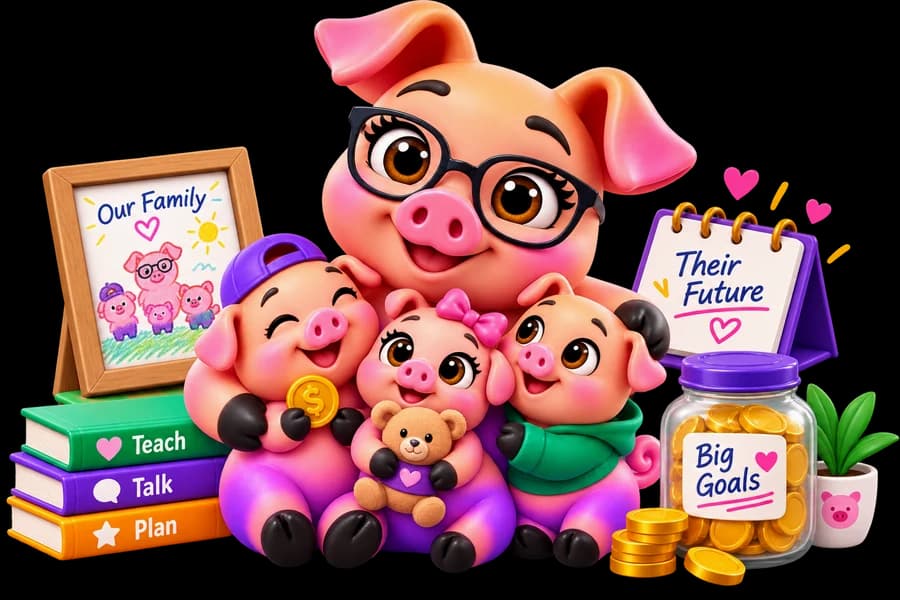
A balance on a screen doesn't teach anything by itself. What teaches is the conversation around it — and those land very differently at six than at sixteen.
These guides cover the human half: allowance structured to teach more than arithmetic, the save-spend-give split and why the third jar is the one that sticks, how to talk about money at each age without it becoming a lecture, and what to do when your kid wants to buy something you know is a bad idea.
Much of this comes from our own house, three kids at three very different stages, written honestly — including the parts that didn't work. You don't need a curriculum, just a handful of moments a year where the money in front of your kid becomes something they understand.
How to Show Your Child Their Investment Account
What should you show your kid about their investments? Start small and add more as they're ready.
Christmas Gifts That Aren't Toys
Too many toys already? Financial and experience gifts that keep meaning something after Christmas.
Financial Literacy Curriculum for High School
What to teach, in what order, to give a teenager real money skills before graduation — a unit-by-unit personal finance sequence for classrooms and homeschools.
Personal Finance Lesson Plans for Every Grade
Ready-to-teach money lessons by grade band — an objective, a hands-on activity, and a takeaway for each, from elementary through high school.
How to Explain Investing to Kids, at Every Age
The explanation that lands for a teen loses a six-year-old. How to explain investing to a kid at every age — with a one-question, four-answer example you can steal.
Financial Literacy for Kids: A Guide by Age
Money skills, layered in at the right age. What financial literacy to teach kids at each stage from 5 to 18 — plus the resources that make it stick.
How to Talk to Your Kids About a Recession
A recession means the economy has slowed down. A simple way to explain what that means to your kid.
The Grandparent Advantage: Give a Grandkid a Head Start That Sticks
You have the two things that build a grandchild's wealth best — time and intent. How to turn a gift into a lesson and a shared story, not just a transfer of money.
Save, Spend, Give: The Three-Jar System for Teaching Kids About Money
Three jars — Save, Spend, Give. The simplest way to teach a kid that every dollar gets a job.
What to Tell Your Kid When the Market Drops
A red day is a lesson, not a scare. How to explain drops by age — and turn a downturn into the best lesson there is.
The Allowance That Actually Teaches
An allowance is a curriculum, not a paycheck. How much, whether to tie it to chores, and what it should teach.
What to Do With Birthday and Holiday Money
Gift cash is the easiest money a kid ever invests. A split that keeps the joy and plants a seed.
Be Your Kid's 401(k): The Parent Match
Match your kid's savings like an employer matches a 401(k) — the trick that makes saving feel like winning.
Teaching Kids to Invest, By Age: From 4 to 18
Concrete, age-appropriate ways to introduce investing — from compound interest at 6 to picking their first ETF at 14.
Other topics
The rest of the library, grouped the same way.
Accounts
20The account types that hold your kid's money — and how each one works.
Strategy
29How to choose between accounts and make the most of what you open.
Taxes
7The tax rules that quietly shape every custodial dollar.
Basics
16Investing fundamentals in plain English — simple enough to learn and teach at the same time.
Milestones
9What to do at the moments that matter — birth, first job, turning 18.